
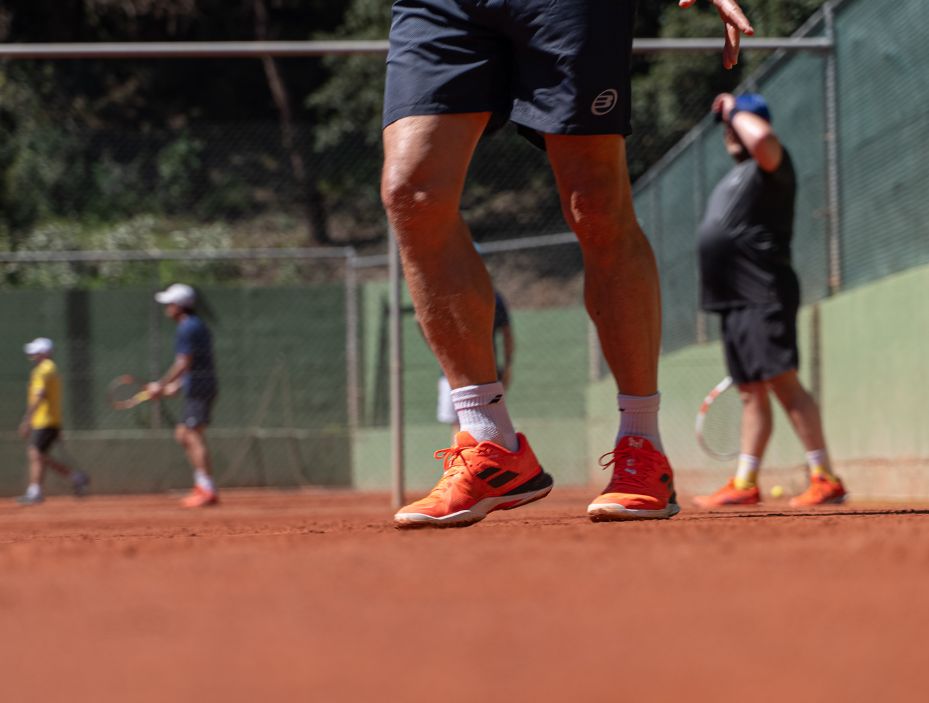
Footwork in tennis is, without a doubt, the true engine of the sport and the invisible factor that separates a mediocre player from an outstanding one. While many amateurs spend hours obsessing over the technique of their forehand or the power of their backhand, they forget that without a solid foundation in movement, those shots will never reach their full potential. The reality is simple: if you don’t arrive on time to the ball or you’re not properly balanced at impact, it doesn’t matter if you own the most expensive racket on the market — the shot will break down.
At Tenis Estepona, we see this every day. Players with enviable arm technique become frustrated because they can’t find consistency in matches. The key is almost always below the knees.
The myth of the “good arm”: the reality of modern tennis
There is a widespread belief that tennis is played with the hands. Nothing could be further from the truth. If you watch top professionals such as Carlos Alcaraz or Rafa Nadal, you’ll notice that their legs never stop moving for a second.
Hitting the ball is merely the final link in a kinetic chain that begins at the ground. Good footwork in tennis allows you to:
- Adjust your distance: neither too close to the ball (letting it crowd you) nor too far away (forcing you to stretch).
- Transfer energy: power comes from driving your legs into the ground, not just from the shoulder muscles.
- Recover quickly: efficient movement enables you to return to the centre of the court before your opponent launches the next attack.
The pillars of footwork: what you need to master
To improve mobility, it’s not enough to simply run a lot — you have to run intelligently. Here are the essential movements broken down:
The Split Step
This is the most important movement and the one most often forgotten. It consists of a small, explosive hop just as your opponent strikes the ball. This brief “bounce” preloads your muscles like springs, allowing you to react in any direction with astonishing speed.
Adjustment steps
Once you’ve moved towards the ball, you can’t stop abruptly. You need small, quick steps to find the perfect hitting distance. That subtle “dance” around the ball is what separates experienced players from beginners.
Balance and centre of gravity
Keeping your centre of gravity low is vital. If you play too upright, you’ll be slow and lose balance against heavy spin or pace. Bending your knees is quite possibly the best piece of tennis advice you’ll ever receive.
Expert note: If your movement feels heavy or you arrive late to wide balls, our tennis classes in Marbella are led by specialised coaches who analyse your biomechanics to correct these habits from the ground up.
Why footwork prevents injuries
It’s not just about performance — it’s also about health. Poor footwork in tennis forces the body to compensate in unnatural ways. If you don’t reach the ball properly, you’ll tend to overuse the wrist or pull with the shoulder just to keep the ball in play.
Over time, this often leads to classic tennis elbow (lateral epicondylitis) or back problems. A player who moves well hits comfortably, and a player who hits comfortably plays without pain.
Practical exercises to improve your mobility
You don’t even need to be on a tennis court to improve. Here’s a simple routine:
- Agility ladder: ideal for coordinating footwork and improving speed in short steps.
- Shadow swings with split step: practise your strokes at home or in the gym, focusing exclusively on the pre-hop and initial movement.
- Lateral shuffle: improves recovery so you can return to the centre after hitting a wide shot.
The mental component: staying “active”
Footwork starts in the mind. Many players make mistakes because their legs “switch off” when they’re tired or when they think the point is already won. Maintaining active feet throughout an entire set requires strong mental discipline.
At Tenis Estepona, we don’t just teach how to hit the ball — we train the mindset of always being ready for the next step. Fatigue usually begins in the mind and shows itself first in feet that stop moving.
Surfaces and footwear: not all courts are the same
Depending on where you play, your footwork must adapt:
- Clay courts: require learning how to slide to reach distant balls.
- Hard courts (resin): demand sharper stops and footwear with greater cushioning to protect the joints.
It’s essential to wear tennis-specific shoes that support the ankle and allow for sudden changes of direction without risking sprains.
The secret lies in the base
Ultimately, if you want to take your game to the next level this year, stop focusing so much on your racket and start paying attention to your feet. Stroke technique is the what, but footwork is the how and the when. Without proper positioning, even the best shot in the world will end up in the net.
If you truly want to transform your game and experience what it feels like to reach every ball with time to spare, we invite you to visit our facilities. At Tenis Estepona, we offer everything from court hire to intensive training programmes where leg work takes centre stage.